
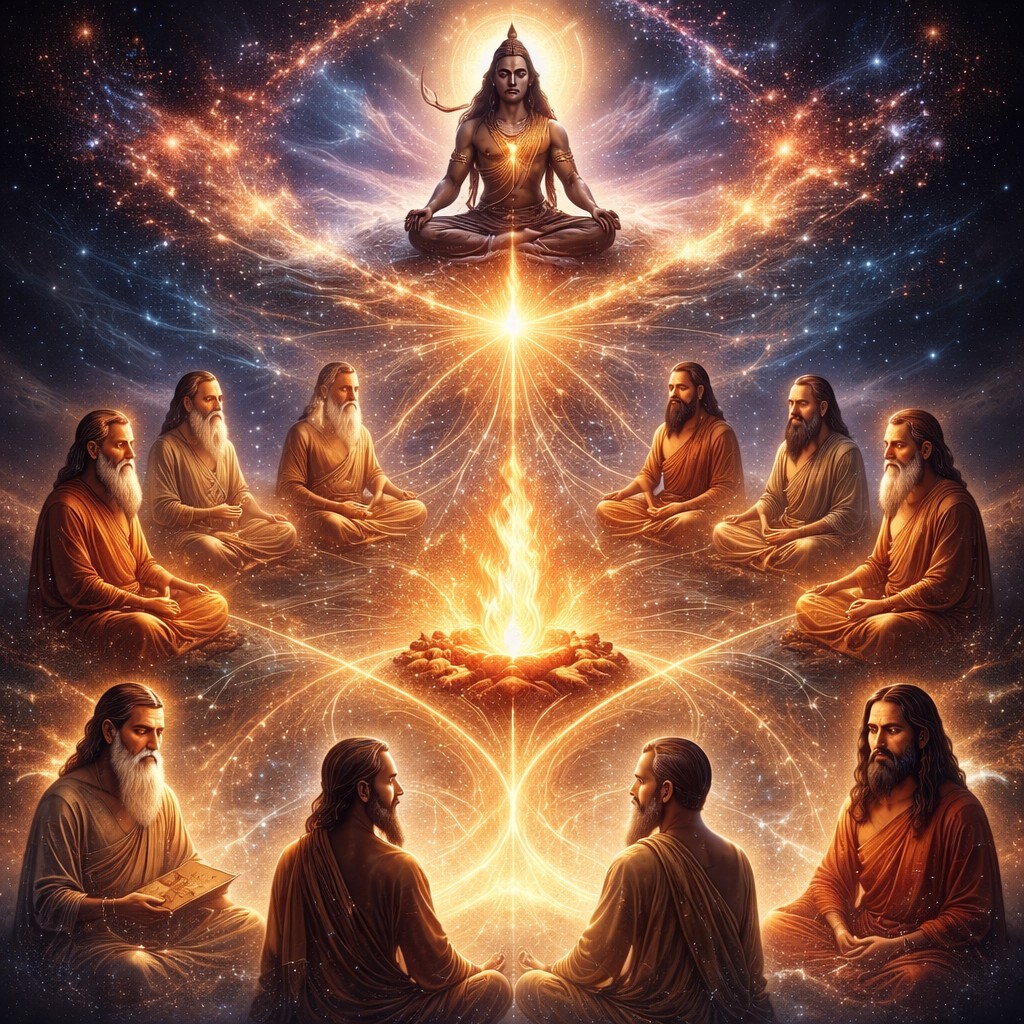
In the previous article, we explored the symbolic origin of Yoga in the figure of the Adiyogi and the initial transmission to the seven sages, the Saptarishis. From that point, the knowledge did not remain static: it began a journey through time, cultures, and generations.
Yoga did not expand as an organized religion or as a closed doctrine. It was transmitted as a living experience.
From the seven sages to living traditions
According to tradition, the seven sages carried the teachings to different regions of the known world. Beyond symbolism, this narrative reflects a deeper truth: Yoga diversified very early on.
There was not a single “yoga,” but multiple approaches that emerged depending on:
Cultural context
Level of spiritual maturity
Needs of the community
Capacity of the teacher
The knowledge adapted without losing its essence.
Oral transmission: the heart of Yoga
For centuries, Yoga was transmitted within the guru–disciple tradition (guru–shishya parampara).
This implied:
A direct and prolonged relationship.
Personalized teaching.
Gradual progression.
Experience before theory.
The teacher did not deliver information; they transmitted method, presence, and correction.
The teaching was not democratic or mass-based. It was intimate and transformative.
From orality to texts
Over time, some teachings began to be systematized in texts.
Among the most influential:
The Upanishads
They explore the nature of the Self (Atman) and its identity with the absolute (Brahman).
The Bhagavad Gita
It integrates different paths of Yoga:
Conscious action (Karma Yoga)
Devotion (Bhakti Yoga)
Knowledge (Jnana Yoga)
Meditation (Dhyana)
The Yoga Sutras of Patanjali
They organize Raja Yoga into eight steps (Ashtanga).
Here we see an important transition:
Yoga begins to take shape as a structured system.
The emergence of lineages
As the practice expanded, specific schools and lineages emerged.
Among them:
🕉 Raja Yoga
Centered on the mind and meditation.
🕉 Hatha Yoga
Developed later, with emphasis on:
Asana
Pranayama
Energetic purification
Texts such as the Hatha Yoga Pradipika show this evolution.
🕉 Bhakti Yoga
The path of the heart and devotion.
🕉 Jnana Yoga
The path of discernment and inner inquiry.
Each lineage represents a different doorway to the same realization.
Yoga in modernity
In the 19th and 20th centuries, teachers began to share Yoga beyond India.
Figures such as:
Swami Vivekananda
Sri Aurobindo
Paramahansa Yogananda
Tirumalai Krishnamacharya
marked the beginning of the globalization of Yoga.
Here a fundamental shift occurs:
Transmission ceases to be exclusively personal and begins to become institutionalized.
Schools, certifications, and group trainings emerge.
Yoga enters into dialogue with science, psychology, and Western culture.
Transformation and risk
This expansion brought two simultaneous movements:
✔ Greater accessibility.
✖ Greater risk of simplification.
Yoga shifted from being an integral path of transformation to sometimes being reduced to a physical practice.
However, the essence remains available.
The question is not what form Yoga takes, but from where it is practiced.
A transmission that continues
The chain of transmission was not broken; it simply changed form.
Today, the teacher may appear:
Within a formal tradition.
In a text.
In consistent practice.
In inner listening.
True transmission does not depend on the format, but on the depth of experience.
From the Adiyogi to the present day, what remains is the invitation:
To practice.
To observe.
To transform.
And thus, the lineage continues—not as history, but as a living experience.