The Structure of the Universe According to The Urantia Book
After exploring the origin and foundations of the revelation, the next natural step is to understand the architecture of the cosmos described in The Urantia Book.
The text presents a deeply structured, hierarchical, and organized universe. It does not describe creation as infinite chaos, but as a living, dynamic system sustained by intelligence and purpose.
Understanding this structure is not merely an intellectual exercise: it transforms the perception of who we are and the place we occupy within the whole.
The universe: order and purpose
From the outset, the book states clearly:
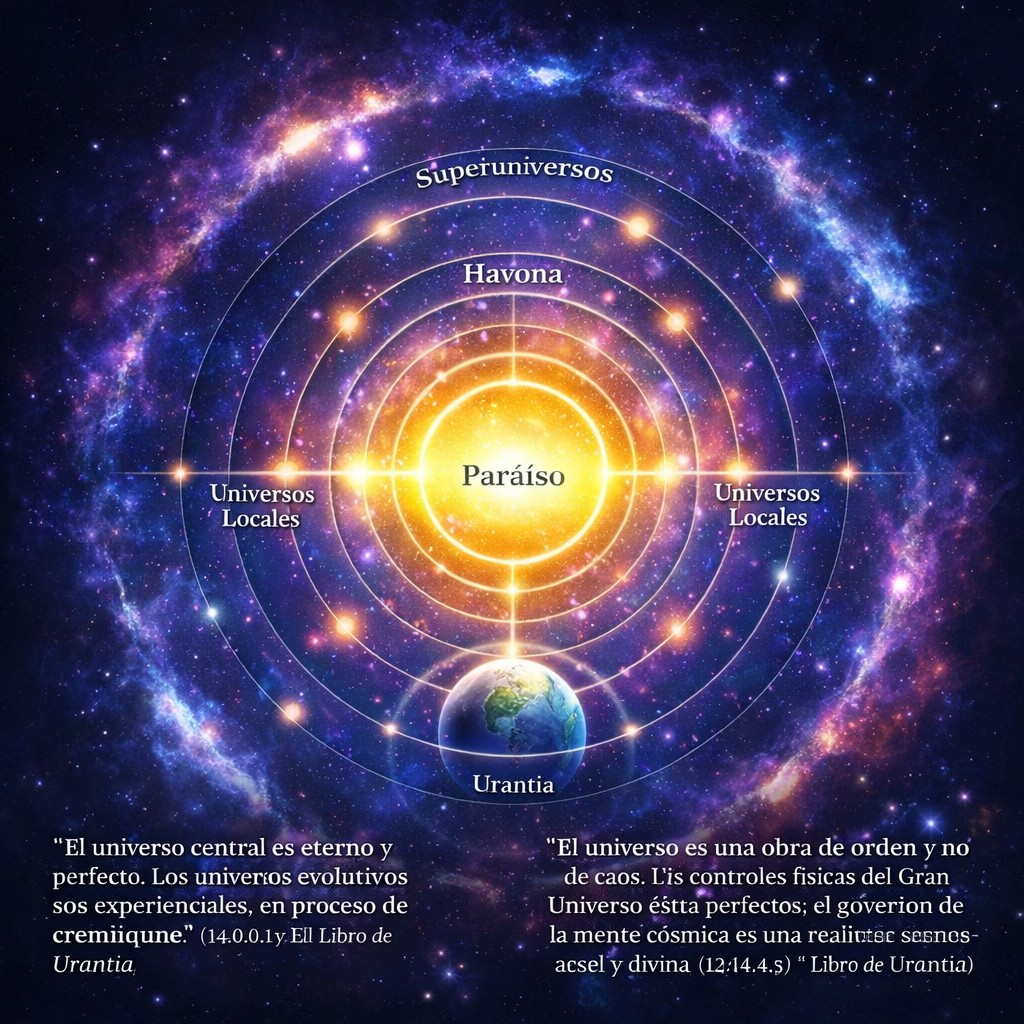
“The universe is a work of order and not of chaos.”
(Paper 12:4.5)
🔗 https://www.urantia.org/es/el-libro-de-urantia/papel-12-el-universo-de-universos
And it adds:
“The universe is neither infinite nor eternal in the absolute sense. Physical creation is a work of time and space.”
(Paper 12:0.1)
🔗 https://www.urantia.org/es/el-libro-de-urantia/papel-12-el-universo-de-universos
Here, a central idea is established: creation is organized within defined limits, within an evolutionary framework.
Paradise: the absolute center
At the heart of all reality lies the Isle of Paradise, described as the eternal and absolute center of the universe of universes:
“The Isle of Paradise is the eternal center of the universe of universes.”
(Paper 11:0.1)
🔗 https://www.urantia.org/es/el-libro-de-urantia/papel-11-la-isla-eterna-del-paraiso
Paradise is not presented as a metaphor, but as a literal reality—the fixed point from which spiritual, mental, and material energies emanate.
Havona: the perfect central universe
Surrounding Paradise is the central universe, called Havona:
“The central universe is eternal and perfect.”
(Paper 14:0.1)
🔗 https://www.urantia.org/es/el-libro-de-urantia/papel-14-el-universo-central-y-divino
Havona is not evolutionary. It is a complete, perfect universe—a model of balance and harmony.
In contrast, the outer universes are in development.
The seven superuniverses
Beyond Havona extend the seven superuniverses, which together form what the book calls the “grand universe”:
“The grand universe consists of the central universe and the seven superuniverses.”
(Paper 15:0.1)
🔗 https://www.urantia.org/es/el-libro-de-urantia/papel-15-los-siete-superuniversos
These superuniverses are evolutionary. Within them, galaxies, local universes, planetary systems, and inhabited worlds develop.
The book describes this organization precisely:
“A local universe consists of one hundred constellations; a constellation consists of one hundred systems; a system consists of approximately one thousand inhabited worlds.”
(Paper 32:0.5)
🔗 https://www.urantia.org/es/el-libro-de-urantia/papel-32-la-evolucion-de-los-universos-locales
This cosmic architecture is one of the most distinctive aspects of the text.
Urantia within the cosmic structure
Earth, called Urantia, is part of:
The system of Satania
The constellation of Norlatiadek
The local universe of Nebadon
The superuniverse of Orvonton
And all of these belong to the evolutionary grand universe.
Regarding this evolutionary dimension, it is stated:
“The universes of time and space are evolutionary.”
(Paper 32:2.11)
🔗 https://www.urantia.org/es/el-libro-de-urantia/papel-32-la-evolucion-de-los-universos-locales
This implies that imperfection, conflict, and growth are part of the process.
Final reflection
This cosmic vision is not meant to fuel imagination, but to expand consciousness. If we inhabit a structured, ordered, and evolutionary universe, then our existence participates in a greater process.
Evolution is not only biological—it is also spiritual.
Understanding the structure of the universe, according to The Urantia Book, invites us to shift the scale of our identity: we are no longer merely isolated individuals on a lost planet, but conscious participants in a developing cosmic architecture.
And perhaps, as we expand our perspective, we also expand our responsibility.